404 - Not Found
It appears the content you were looking for has moved or has been removed. Please try using the Search Page to find it.
Thank you.


Discover essential strategies and resources to navigate the financial aid application process effectively.
Start your financial aid journey with FAFSA tips, planning tools, and local support.
Explore our diverse range of financial aid programs designed to support students in achieving their educational goals.
Find reputable scholarship search tools and tips to help you discover private financial aid opportunities early and apply successfully.
Tools and resources for our partners supporting students and their families.
Covers training opportunities, webinars, and events for college access professionals.
Contains current and past ISAC rules, along with any proposed rule changes.
Education, and how we think about and act on it, is transforming. As it evolves, so do we.
Provides data tools and resources to support FAFSA completion efforts.
Stay current on federal financial aid policies and updates.
Access flyers, toolkits, and resources for student outreach.
Provides information and tools related to the Postsecondary and Career Expectations (PaCE) framework.
Find quick links to key resources, forms, and websites.
Includes announcements, program changes, and important updates for ISAC partners.
Features relevant state legislation governing ISAC programs and services.
Explains how to use ISAC’s secure system for sending high school transcripts electronically.
It appears the content you were looking for has moved or has been removed. Please try using the Search Page to find it.
Thank you.
Loan rehabilitation is the process in which a borrower may bring a student loan out of default by adhering to specified repayment requirements. This process is different and separate from Title IV Reinstatement.
The following is a brief explanation of loan rehabilitation. The process is explained in more detail in the Common Manual.
To rehabilitate a defaulted loan, the borrower must make 9 voluntary, full payments during a period of 10 consecutive months. The payments must be made within 20 days of the due date. However, a borrower may start over if unable to fully meet these requirements within a consecutive ten-month period. A lump sum prepayment of future installments cannot be used to satisfy the consecutive months payment requirement.
"Voluntary payments" are those made directly by the borrower. Borrowers with loans in an involuntary payment status such as judgment, garnishment, administrative wage garnishment, income or asset execution, federal or state tax offset must contact ISAC to determine if they qualify for loan rehabilitation.
For purposes of loan rehabilitation, "full payments" mean "reasonable and affordable" payments agreed to by the borrower and ISAC. The required monthly payment amount may be no more than is reasonable and affordable based upon the borrower's total financial circumstances.
Approximately 60 days after the borrower has made the required payments and the signed Rehabilitation Agreement has been received, ISAC will place the borrower with a lender that will purchase the loan(s). At that time, the borrower is considered to have rehabilitated the loan and is again eligible for all benefits of the program, including any remaining deferment eligibility.
Borrowers should contact an ISAC Call Center Representative at [email protected] or 800.899.4722 with any questions.
ISAC is proud to recognize the 539 Illinois high schools that went above and beyond to support the Class of 2026. Your dedication helps ensure every student has the funding they need for the future.
Each recognized school will receive a custom banner to proudly display on campus, celebrating your commitment to the Class of 2026.

Platinum Medals
above 95%
45 Schools

Gold Medals
above 85%
103 Schools

Silver Medals
above 75%
146 Schools

Bronze Medals
above 65%
175 Schools
The role and mission of the Illinois Student Assistance Commission (hereinafter “ISAC”) is to provide Illinois students with information and assistance to help make education beyond high school accessible and affordable. ISAC is committed to promoting equity and inclusivity. To that end, it is ISAC’s policy to make reasonable efforts to provide limited English proficient (LEP) individuals with Language Assistance Services that provide meaningful access to ISAC’s services, programs, and activities. ISAC interacts with the public via telephone services, email, online mediums, and in person.
ISAC’s Language Access Program (LAP) Plan supports the agency’s Diversity, Equity, Inclusion, and Accessibility (DEIA) goals of formally and fully integrating DEIA programming and oversight into existing operational framework of ISAC, such as the LAP Plan, and contributing to the scale and sustainability of impactful state-wide DEIA efforts in the State. While the Illinois Language Equity and Access Act makes reference to individuals with limited English proficiency LEP, ISAC’s LAP Plan intends to support all individuals who use languages other than English as their primary language. Therefore, this Plan uses “LEP” to be inclusive of individuals who use languages other than English as their primary language, as there is no standard definition for limited proficiency of English.
In accordance with federal and state requirements, this LAP Plan provides a framework for ensuring ISAC can deliver timely and meaningful language assistance services to ISAC’s constituents with limited English proficiency (LEP). ISAC will operationalize this commitment to language access by:
The purpose of this policy is to establish effective guidelines, consistent with Title VI of the Civil Rights Act of 1964, Executive Order 13166, and the Illinois Language and Equity and Access Act (15 ILSC 56) for agency personnel to follow when providing services to or interacting with individuals who have limited English proficiency (LEP). See Appendix IV – Legislative References for more information on: Title VI of the Civil Rights Act of 1964; Illinois Civil Rights Act of 2003; Illinois Human Rights Act; and Illinois Language Equity and Access Act.
This Language Access Program (LAP) Plan applies to all ISAC staff.
Eddie Brambila (Managing Director, College Access Systems) named as LEP Language Access Coordinator, supported by Sam Nelson, Director of Organizational Development.
In order to assess whether there is meaningful access to programs and activities by LEP persons, a four-factor analysis is set out in guidance issued with Executive Order 13166. The four-factor analysis considers (1) the number or proportion of LEP persons eligible to be served or likely to be encountered by the program; (2) The frequency with which LEP individuals come in contact with the program; (3) The nature and importance of the program, activity, or service provided by the program to people’s lives; and (4) The Resources available to the grantee/recipient and costs.
Factor 1: The number or proportion of LEP persons eligible to be served or likely to be encountered by the program. ISAC’s responsibilities primarily consist of providing information and resources to Illinois residents seeking post-secondary education in the State of Illinois. As a result, nearly 100% of the student population that ISAC serves is highly proficient in English. However, on occasion a student’s family member, or other person seeking assistance on the student’s behalf is an LEP individual; for these individuals ISAC will provide services to meet their language needs.
In 2026, ISAC is using the following findings from a demographic analysis[1] conducted by the University of Illinois Chicago in partnership with the Office of New Americans on the State’s individuals with limited English proficiency and individuals with LEP:
Eleven languages have more than 10,000 limited-English speakers in Illinois, including:
| Largest Language Groups | Largest Limited-English Language Groups | ||
|---|---|---|---|
| Language | # of Speakers | Language | # of Speakers |
| Spanish | 1,638,222 | Spanish | 616,760 |
| Polish | 169,308 | Polish | 73,843 |
| Chinese* | 106,399 | Chinese* | 51,494 |
| Filipino, Tagalog | 86,051 | Filipino, Tagalog | 23,198 |
| Arabic | 67,017 | Arabic | 20,342 |
| Urdu | 56,122 | Korean | 20,165 |
| Gujarati | 50,196 | Gujarati | 18,762 |
| Hindi | 47,274 | Russian | 17,649 |
| Russian | 44,211 | Vietnamese | 13,966 |
[1]See Rob Paral, “Language Needs Assessment Report,_ Office of New Americans, Office of the Governor of Illinois, Great Cities Institute at the University of Illinois Chicago (2025), https://arcg.is/1Py4n0
Factor 3: The nature and importance of the program, activity, or service provided by the program to people’s lives. ISAC is unique in that it serves the People of the State of Illinois who are seeking higher education. Although college is an important aspect of a person’s life, it is not critical to their liberty, health, safety, or other vital needs.
In order to receive any of the scholarship and grant programs provided through ISAC, students must be enrolled in a degree-seeking program at an eligible postsecondary institution in the State of Illinois. These financial aid eligible programs are provided in English; hence, students need to have proficiency in English in order to be enrolled in these financial aid eligible programs and receive the financial aid assistance these programs provide.
ISAC provides program information and services to all individuals in the state seeking postsecondary education. The majority of our outreach services and activities are with current high school students at the request of high school counselors and administrators, or professionals from a community-based or non-profit organization supporting students, reaching out to ISAC for that student assistance and support for the college going and financial aid process.
These services include one-on-one and small group meetings with students, as well as college admission and financial aid workshops and presentations. While most workshops and presentations are done in English, some workshops and presentations may be done in Spanish, as ISAC has Spanish speaking outreach staff, when the audience may include parents and other family members supporting their student who are LEP individuals. These are not ISAC sponsored or hosted presentations; these are events hosted and sponsored by the school or other organization. ISAC staff are guest speakers and do not determine who attends or if registration or security processing is required to attend the event (e.g., some events are in school buildings that might have certain security requirements). While these presentations events are not ISAC sponsored, the agency does track and can report how many events for external partner hosted events are provided in Spanish as guest speakers.
Conclusion: The foregoing four-factor analysis indicates that ISAC’s LEP services to date (as identified in this Language Access Program Plan) have been effective and therefore are reasonable.
ISAC identifies LEP individuals who contact ISAC through correspondence (via U.S. mail, fax, e-mail, or website inquiry), telephonically or in person, and who may need language assistance. At an ISAC office location, visitors will be met with posted information on LEP services and how to access them. All public-facing employees will receive training on offering and providing LEP services. ISAC staff will offer free LEP services to all students, a student’s family member, or other person seeking assistance on the student’s behalf if that person is an LEP individual.
As ISAC shares offices space in our Deerfield office building with a common public lobby area with the Illinois Department of Children and Family Services (DCFS) and the Illinois Department of Veterans Affairs (IDVA), ISAC will work with the other two agencies to coordinate language resources information and signage to be displayed in the lobby area.
Upon determining the need that language assistance services are needed for a LEP individual, ISAC will make efforts in accordance with its LAP Plan to ensure that necessary communications are conducted by bilingual staff members or other qualified interpreters. If there are no available ISAC staff who can serve as interpreters, the contracted vendor for such services will be contacted.
Note: An individual with LEP may provide an interpreter of his or her own choosing at his or her own expense. Extra caution should be exercised when the LEP person chooses a minor as the interpreter. While the decision of an individual with LEP should be respected, there may be issues of competency, confidentiality, or conflict of interest when the choice involves using children as interpreters. The interpreter provided by the LEP individual should be used as a supplement to the interpreter services provided by ISAC.
ISAC’s Telecom Coordinator will complete an Illinois Department of Innovation & Technology (DoIT) Telecommunication Service Request (TSR) requesting Propio services for designated ISAC phone numbers via requests for service from ISAC’s Student Engagement Center submitted via email to [email protected]. The TSR will include ISAC’s information including phone numbers for Propio services (phone numbers cannot be cell phone numbers. The TSR information is also used for invoicing and accounting purposes.
There is an interpreter feedback mechanism. Questions, concerns, or feedback with regard to the telephonic interpreter session, including the quality of the telephonic interpretation, should be made directly to ISAC’s General Counsel staff at [email protected] & Procurement Department staff at [email protected].
Illinois Deaf and Hard of Hearing Commission (IDHHC)
Attn: Interpreter Complaint Department
528 South 5th Street, Suite 209
Springfield, IL 62701
Voice: 877-455-3323 or 217-557-4495*
Video Phone: 217-303-8010
TTY: 888-261-2698
Fax: 217-557-4492
https://www.illinois.gov/idhhc/community/Pages/InterpreterComplaint.aspx
*For individuals calling the “voice” number, IDHHC calls are directed through the Federal Communications Commission’s video relay system to accommodate Deaf staff.
To elevate any complaints not adequately addressed through the above processes, complaints and concerns may also be made to the Governor’s Office of New Americans (ONA) at [email protected].
Training materials are being updated to include information from the Illinois Language Equity and Access Act, including the new reporting requirements and other guidance from the ONA. In addition to detailed training being provided to public-facing staff as they move into a new position and on an annual basis for all public-facing staff, ISAC will be expanding training about the agency’s ability to provide services to persons whose primary language is not English to all agency staff who are not in a public-facing role on an annual basis.
The training for all agency staff who are not in a public-facing role will be more general without the level detail required for public-facing positions but will include how staff can be aware of our language access services in the event they encounter LEP individual in a personal or professional and to whom at ISAC public-facing staff to direct that individual. This all-staff training will help raise aware that the agency does have the capacity to provide services to LEP individuals and the importance in providing services to persons whose primary language is not English to promote a culture of understanding and broader support.
(Reviewed and updated 11/24/2025)
Public Service Loan Forgiveness (PSLF) Presentation Request Form
Free Application for Federal Student Aid (FAFSA®) – for Monetary Award Program (MAP) Grant
Alternative Application for Illinois Financial Aid
Illinois National Guard (ING) Grant Program Application
Illinois Veteran Grant (IVG) Program Application
Deceased, Disabled, and MIA-POW Veterans’ Dependents Scholarship Application
Grant Program for Dependents of Police or Fire Officers Application
Grant Program for Dependents of Correctional Officers Application
Grant Program for Exonerees Application
Minority Teachers of Illinois (MTI) Scholarship Program Application/Teaching Agreement/Promissory Note
Illinois Special Education Teacher Tuition Waiver (SETTEW) Program Application/Teaching Agreement/Promissory Note
Early Childhood Access Consortium for Equity (ECACE) Scholarship Program Application/Promissory Note
Displaced Energy Worker Dependent Transition Scholarship Program Application
Post-Master of Social Work School Social Work Professional Educator License Scholarship Program Application/Promissory Note
Optometric Education Scholarship Program Application
Nursing Education Scholarship Program (NESP) Application/Promissory Note/Grant Agreement
Nurse Educator Loan Repayment Program Application
Community Behavioral Health Care Professional Loan Repayment Program Application
Illinois Teachers Loan Repayment Program Application
John R. Justice Student Loan Repayment Program Application
School and Municipal Social Work Shortage Loan Repayment Program Application
Veterans’ Home Medical Providers’ Loan Repayment Program Application
Golden Apple Scholars of Illinois
Deceased, Disabled, and MIA-POW Veterans' Dependents Scholarship
Illinois Graduate and Retain our Workforce (iGROW) Tech Scholarship Program
Human Services Professional Loan Repayment Program
State Scholars Program
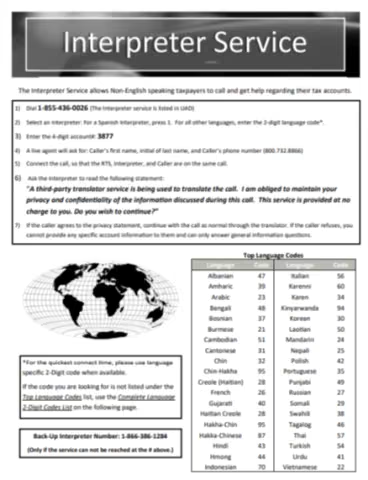
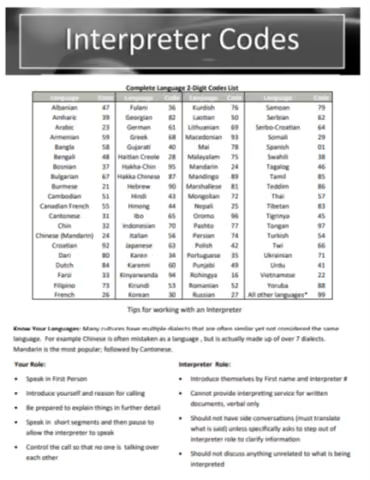
Accessed current card info at https://doit.illinois.gov/content/dam/soi/en/web/doit/documents/services/catalog/telecom/Propio-Interpreter-Insructions.pdf and list of all codes information https://propio.com/language-codes/ – 4/30/2025
As DoIT continues to strive to make the Propio Tele interpreter customer experience as user friendly as possible, we have implemented some changes to the process of connecting with an Interpreter to streamline DoIT’s process of handling Interpreter calls.
The New Propio Instruction Card Template below is how new request access cards will look. If you have the old card format, please use the new format below to access an interpreter in the future.
If you have any questions, please contact [email protected] or call 217-557-1652.
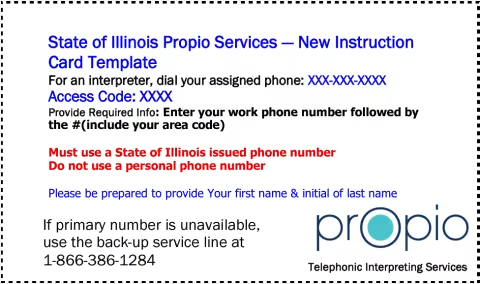
For an interpreter, dial your assigned phone·: XXX-XXX-XXXX Access Code: XXXX
Provide Required Info: Enter your work phone number followed by the #(include your area code)
Must use a State of Illinois issued phone number
Do not use a personal phone number
Please be prepared to provide Your first name & initial of last name
If primary number is unavailable, use the back-up service line at 1-866-386-1284
| Language | Code | Language | Code |
|---|---|---|---|
| Amharic | 39 | Kinyarwanda | 94 |
| Arabic | 23 | Korean | 30 |
| Bengali | 48 | Mandarin | 24 |
| Burmese | 21 | Nepali | 25 |
| Cantonese | 31 | Portuguese | 35 |
| French | 26 | Russian | 27 |
| Haitian Creole | 28 | Somali | 29 |
| Hakha-Chin | 95 | Swahili | 38 |
| Hmong | 44 | Vietnamese | 22 |
| Karen | 34 | All Other | 8 |
Complete list online: LanguageCodes.info
Employees reviewing translations and/or those requesting internal reviews should follow these guidelines to ensure quality. The process can be divided into three broad steps.
Translated materials, too, should be field-tested. A simple way of doing this is by working with community providers, community members, and/or bilingual ISAC staff. They can review your documents and provide valuable input.
Title VI of the Civil Rights Act of 1964 – Title VI of the Civil Rights Act of 1964 (42 U.S.C. § 2000d) (Title VI) prohibits discrimination on the basis of race, color, or national origin in any program or activity receiving federal financial assistance. As a recipient of federal financial assistance, the [Department/Agency] is bound by Title VI of the Civil Rights Act of 1964 (Title VI), 42 U.S.C. §§ 2000d-2000d-7, and its implementing regulation, 45 C.F.R. Part 80, which prohibits discrimination based on race, color, or national origin (which includes Limited English Proficiency).
Illinois Civil Rights Act of 2003 – The Illinois Civil Rights Act prohibits State, county, or local government in Illinois from excluding a person from participation in, denying a person the benefits of, or subjecting a person to discrimination under any program or activity on the grounds of that person’s race, color, national origin, or gender. Additionally, the Illinois Civil Rights Act prohibits using criteria or methods that have a discriminatory effect.
Illinois Human Rights Act (IHRA) – The Illinois Human Rights Act consolidates existing laws and administrative processes addressing civil rights in Illinois. IHRA prohibits discrimination in employment, housing, financial credit, and public accommodations because of race, color, sex, religion, ancestry, national origin, age, physical or mental disability, unfavorable military discharge, and marital status, as well as retaliation for opposing discrimination. IHRA established the Illinois Department of Human Rights (IDHR) and the Illinois Human Rights Commission (IHRC) as enforcing agencies.[1]
Illinois Language Equity and Access Act – Signed into law by Governor Pritzker in 2024, the Language Equity and Access Act 2024 aims to ensure that all residents can access state information, programs, and services equitably, and that limited English proficiency does not prevent anyone from fully participating in civic life.[2] The Act aims to ensure all Illinois residents, including individuals with LEP, have meaningful and equitable access to state services, programs, information, and activities by removing language barriers. The act incorporates federal guidance for ensuring meaningful access for individuals with LEP and other federal and state legislation that prohibit discrimination based on national origin and promote language access, including Title VI of the Civil Rights Act of 1964, the Illinois Human Rights Act of 1979, and the Illinois Civil Rights Act of 2003.[3]
The Act designates the Governor’s Office of New Americans (ONA) as the lead agency responsible for coordinating the implementation of statewide language access policy, with the support of the Department of Human Services. ONA is tasked with providing oversight, offering technical assistance, and ensuring agency compliance with the Act’s requirements.
Under the Act, the ONA will lead the development of a Language Needs Assessment Report using U.S. Census data to identify the languages spoken across Illinois and inform agency planning. All state agencies will develop Language Access Plans that will inform how the agency will ensure meaningful access to individuals with LEP, appoint a Language Access Coordinator (LAC) to oversee implementation within each agency, and translate vital documents and provide qualified interpretation services for LEP populations.
[1] https://dhr.illinois.gov/about-us/directors-office/agency-overview-and-history.html
[2] See Language Equity and Access Act, Public Act 103-0723, 103rd Gen. Assem. (Ill. 2024), https://www.ilga.gov/legislation/publicacts/fulltext.asp?Name=103-0723.
[3] See Language Equity and Access Act, Pub. Act 103-0723.
Check out these free, easy-to-use online tools to help you and your family estimate college costs and the amount of financial aid you might receive. You will also find tools to help with budgeting, saving, and learning about money. Our worksheets and partner resources can help you compare financial aid offers you receive from colleges and universities so you can make an informed college decision.

Estimates your eligibility for federal student aid. This includes the Pell Grant, federal work study and student loans. It can also help you estimate your Student Aid Index (SAI), which is a number that the federal government uses as a guide to determine your financial need.
You will need your SAI to use the Monetary Award Program (MAP) Estimator, below.
Planning to attend an Illinois college? Use the MAP Estimator to get an idea of your eligibility for the Illinois Monetary Award Program (MAP). If you are a dependent student, you will need the following to use the tool:
If you don’t already know your SAI, find it using the Federal Student Aid Estimator.
Helps you pick a repayment plan that is best for you and estimates loan payments. This simulator can also help you determine if loan consolidation might be an option for you.
Mapping Your Future offers free, easy-to-use calculators and a helpful 12-Step Guide to Financial Success. You can learn about smart credit card use, investing, loan repayment, and much more. Calculators can help with budgeting, savings, loan consolidation, and debt-to-salary comparisons.
Financing is a big part of planning for college. This calculator provides an estimate of how much college may cost when a student is ready to attend. With careful planning and the help of financial aid, funding a college education can be achieved. To get an idea of how much financial aid you might be eligible for, use the Federal Student Aid Estimator and MAP Estimator.
| Public Community College | Public 4-Year College | Private 4-Year College |
|---|---|---|
| $21,320 | $30,990 | $65,470 |
| * National average cost estimates are from the College Board and are updated each fall (next update is anticipated for fall 2026). Actual costs are determined by individual colleges every fiscal year. | ||
Note: Please do not use commas.
Disclaimer: Calculators are provided for reference only. Any rates and costs are subject to change without notice. The costs, rates or payment amounts provided from these calculators are not guaranteed.
This calculator helps assess one’s current savings plan. Use it to estimate the savings plan’s value at the time a student is ready for college.
Note: Please do not use commas.
Disclaimer: Calculators are provided for reference only. Any rates and costs are subject to change without notice. The costs, rates or payment amounts provided from these calculators are not guaranteed.
A savings goal is more easily attainable when the target sum needed is broken into smaller monthly amounts. Use this calculator to determine how much money should be saved each month to cover college costs.
Note: Please do not use commas.
Disclaimer: Calculators are provided for reference only. Any rates and costs are subject to change without notice. The costs, rates or payment amounts provided from these calculators are not guaranteed.
Learn and test your knowledge about student financial aid with this fun interactive quiz. Do you know your stuff?
You’ve received financial aid offers to the schools you have been admitted to, but now you want to compare offers to help you decide which school is right for you. Check out these free tools to help you make an informed financial decision about college.
Use this worksheet to compare financial aid offer letters (up to 3) that you’ve received from colleges and universities to which you’ve been admitted. Offer letters detail how much a college can offer in terms of financial assistance.
If you don't already know it, use the Federal Student Aid Estimator to find out.
To save your Comparison Worksheet, you will need to login and create a profile.
View actual financial aid offers students similar to you have received from the same and comparable colleges.
| Early Childhood Access Consortium for Equity Scholarship | Golden Apple Scholars of Illinois | Illinois Special Education Teacher Tuition Waiver | Teachers of Illinois Scholarship | TEACH Grant Program (Federal program) | |
|---|---|---|---|---|---|
| Priority Application Date | May 19, 2025 | April 1, 2025 | March 1, 2025 | February 16, 2026 | No set date |
| Maximum Award (cannot exceed the cost of attendance) | Up to $7,500 per academic year | Up to $2,500 during the first or second year as a Golden Apple Scholar and up to $5,000 during the third, fourth, or fifth year as a Scholar | Exemption from paying tuition and mandatory fees for up to 4 calendar years | Up to $7,500 per academic year, maximum of 8 semesters or 12 quarters | Up to $4,000 per academic year |
| Eligible Expenses Covered | Up to the total cost of attendance after other financial aid. Cannot exceed cost of attendance. | Tuition, mandatory fees, room and board (or commuter allowances), Cannot exceed cost of attendance when combined with other aid. | Tuition and mandatory fees | Up to the total cost of attendance after other financial aid. Cannot exceed the cost of attendance. | Up to the total cost of attendance after other financial aid. Cannot exceed cost of attendance. |
| Eligible Institutions | Gateways-entitled and ECACE-member public or non-profit private 2- or 4-year institutions | Golden Apple Foundation-approved Illinois public and private colleges | ISAC-approved Illinois public 4-year colleges offering a concentration in special education | ISAC-approved Illinois public or private colleges | Institutions participating in the TEACH Grant Program |
| Eligible Program of Study | Associate of Applied Science degree (or related certificate) in early childhood education, associate degree with a concentration in early childhood education, or a bachelor’s degree in early childhood education, with or without a Professional Educator License. Students who already hold a bachelor’s degree in early childhood education are not eligible. | Postsecondary course of study leading to an initial teacher licensure or taking additional courses needed to gain Illinois State Board of Education (ISBE) approval to teach, including alternative teacher licensure | Coursework required for initial licensure in any area of special education as determined by the university | Coursework required for initial teaching licensure including alternative teacher licensure, teaching endorsement or master’s degree, or teacher licensure after receiving a College and Career Pathway Endorsement | Undergraduate and/or post-baccalaureate coursework necessary to begin a career in teaching |
| Teaching Commitment | Recipients are expected to continue or return to teaching or providing direct services in the early childhood care and education field in the State of Illinois after completion of their program of study | Recipients must sign a promissory note and commit to teaching full time for at least 5 years at an eligible school, beginning within 2 years of completion of their program of study | Recipients commit to teaching full time for at least 2 of the 5 years immediately following completion of their education, beginning within 1 year of completion of their studies | Recipients commit to teaching full time at an eligible school for at least 1 year per year they received scholarship assistance, beginning within 1 year of completion of their studies | Recipients commit to teaching full time for at least 4 years in a high-need field in a qualifying school or educational service agency within 8 calendar years after completion of their studies |
| Repayment (if teaching commitment is not fulfilled) | None | 5% interest accrues from the repayment date if teaching commitment is not fulfilled | 5% interest accrues from the repayment date if teaching commitment is not fulfilled | 5% interest accrues from repayment date if teaching commitment is not fulfilled | Conversion to a Federal Direct Unsubsidized Stafford Loan with interest rate equal to current loan rate accrues from disbursement date if teaching commitment is not fulfilled |
| Special Considerations | Recipients who accept a Golden Apple Scholars of Illinois Program award may not accept an Illinois Special Education Teacher Tuition Waiver or Teachers of Illinois Scholarship for the same academic period. | Recipients who accept a Special Education Teacher Tuition Waiver award may not accept a Golden Apple Scholars of Illinois Program award or Teachers of Illinois Scholarship award for the same academic period. | Recipients who accept a Teachers of Illinois Scholarship award may not accept an Illinois Special Education Teacher Tuition Waiver or Golden Apple Scholars of Illinois Program award for the same academic period. |
The morning fog clung to the harbor like a reluctant memory, softening the edges of the old wooden docks and muting the cries of the gulls overhead. James stood at the railing of his weathered porch in York Harbor, Maine, coffee mug warm in his hands, watching the tide slowly reveal the barnacle-crusted rocks below. The air carried that unmistakable mix of salt, pine, and distant woodsmoke— a scent that always made him feel both grounded and quietly restless. Another day stretched ahead, full of small decisions and larger unknowns, the kind that quietly shape a life without announcement.

Further inland, the forest held its own secrets. Ancient maples and towering pines stood sentinel over moss-covered trails that wound through centuries of fallen leaves and forgotten stone walls. Here, time moved differently. A single shaft of sunlight piercing the canopy could feel like a revelation, while the rustle of unseen wildlife reminded every hiker that they were merely guests in a much older story. Nature didn’t rush; it simply endured, patient and indifferent to human schedules.
In the quiet hours between dusk and dreams, thoughts often drifted toward possibility. What if the next turn in the road led somewhere unexpected? What if the ordinary routines we cling to were hiding extraordinary chances just beneath the surface? Life, after all, rarely announces its plot twists with fanfare. It prefers subtlety— a chance conversation, a sudden insight at 3 a.m., or the way a familiar landscape can suddenly look brand new when seen through fresh eyes.
Would you like me to generate more paragraphs, adjust the theme, style, or topic? Just let me know!

The morning fog clung to the harbor like a reluctant memory, softening the edges of the old wooden docks and muting the cries of the gulls overhead. James stood at the railing of his weathered porch in York Harbor, Maine, coffee mug warm in his hands, watching the tide slowly reveal the barnacle-crusted rocks below.

The air carried that unmistakable mix of salt, pine, and distant woodsmoke— a scent that always made him feel both grounded and quietly restless. Another day stretched ahead, full of small decisions and larger unknowns, the kind that quietly shape a life without announcement.